

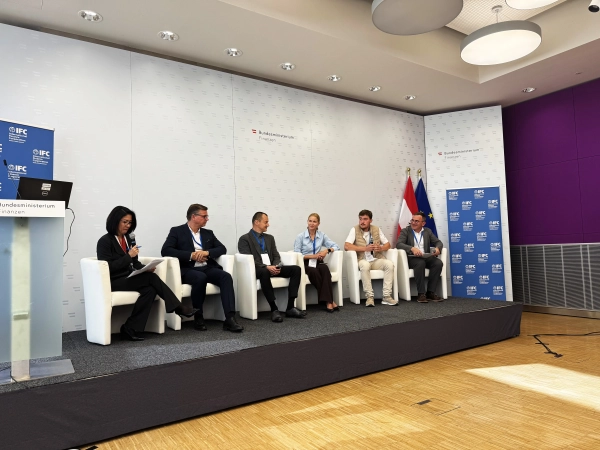
A strategic meeting of representatives from the World Bank, IFC, and international financial institutions focused on Ukraine’s recovery took place in Vienna on October 2-3.
The participants discussed key reform directions, investment priorities, and mechanisms for attracting private capital to the reconstruction process.
The DIM Group of Companies was represented at the Vienna forum by Junior Partner Arseniy Nasikovsky. He held a series of meetings with Austrian and European manufacturers, bank executives, and IFC representatives. He also participated in a roundtable discussion on the investment future of development projects in Ukraine, urging international investors to engage in active collaboration.
“Russia’s invasion of Ukraine has caused immense destruction and the disappearance of entire cities. Over 10% of the housing stock has been destroyed or damaged, and millions have been forced to leave their homes. This presents not only a humanitarian challenge but also a historic opportunity for Ukrainian developers. Reconstruction will require a vast quantity of not only construction materials but, most importantly, the expertise of companies that can offer modern solutions for rebuilding housing, developing industrial and commercial enterprises, creating new jobs, and integrating the Ukrainian market into the European economic space,” emphasized Arseniy Nasikovsky.
According to World Bank estimates, direct war-related damages by the end of 2024 exceed $176 billion, with total recovery needs approximating $524 billion, equivalent to 2.8 times Ukraine’s GDP.
The most affected sectors include:
- the housing sector – over $57 billion (33%);
- transportation – $36 billion (21%);
- energy and extraction industries – $20 billion (12%);
- commercial real estate and industry – $17 billion (10%);
- education and science – $13 billion (8%).
International partners emphasized that the key principle is the “Build Back Better” approach, focusing on energy efficiency, inclusivity, and long-term sustainability. Ukraine’s recovery should be grounded in major structural reforms:
- modernizing the business environment and harmonizing regulations with the EU;
- stimulating trade and competition;
- attracting foreign and domestic investments;
- building a competitive, export-oriented economy;
- emphasizing “green” and digital technologies, resilience, and compliance with EU standards.
As Arseniy Nasikovsky noted, the Ukrainian development market possesses immense potential, but its realization requires a proactive stance from market players, investment attraction, partner search, transparency, and adherence to international operational standards.
“DIM has already taken a step in this direction by attracting a strategic partner for the implementation of existing and the launch of new landmark projects totaling over 935,000 sq. m. for the Ukrainian market in the coming 10 years. Based on the results of 2024, the company is among the top 3 developers in Kyiv and ranks 7th in Ukraine by volume of housing commissioned. However, only transparent reporting, auditing, and the implementation of ESG standards can open the door to the trust of international investors. We have experience cooperating with CBRE – we were the first among developers in the Ukrainian real estate market to conduct a construction audit, and by the end of the year, we plan to be the first to conduct a financial audit. This is the only correct path for Ukrainian developers to obtain international investments,” emphasized Arseniy Nasikovsky.
The forum also paid special attention to the issue of developing affordable housing. During a roundtable organized with the participation of developers, investors, and World Bank experts, the challenges and prospects of this segment were discussed.
According to World Bank estimates, 13% of Ukraine’s housing stock has been destroyed or damaged, amounting to over 2.5 million households. The cumulative housing deficit is up to 7 million apartments, of which 5-7 million are war consequences, and about 1 million are additional demand due to internally displaced persons (over 5 million officially registered).
Currently, experts estimate the sector’s potential at nearly 90-170 million sq. m. of new housing over the next 10 years, creating a powerful multiplier effect for the construction industry, employment, and investment.
International partners also stressed the need to develop domestic production of key building materials – cement, steel, glass, and insulation, which constitute up to half of reconstruction costs. This will reduce import dependency, mitigate logistical risks, and make the reconstruction process more resilient.
IFC experts highlighted that reconstruction efforts in Ukraine could generate demand equivalent to over 15% of the current global construction materials market. This, in turn, opens significant opportunities for Austrian and European companies, which, through their innovations and sustainable practices, can play a leading role in the recovery process.
“We understand that rebuilding Ukraine is not just a matter of square meters. It is about energy efficiency, environmental friendliness, and a new quality of life. The Ukrainian market currently needs innovation, partnerships, including with European companies, and localization of production. The DIM Group of Companies aims to be among those setting this standard and offering solutions that will remain relevant for decades to come,” emphasized Arseniy Nasikovsky.
Date: 07.10.2025 Source: DIM